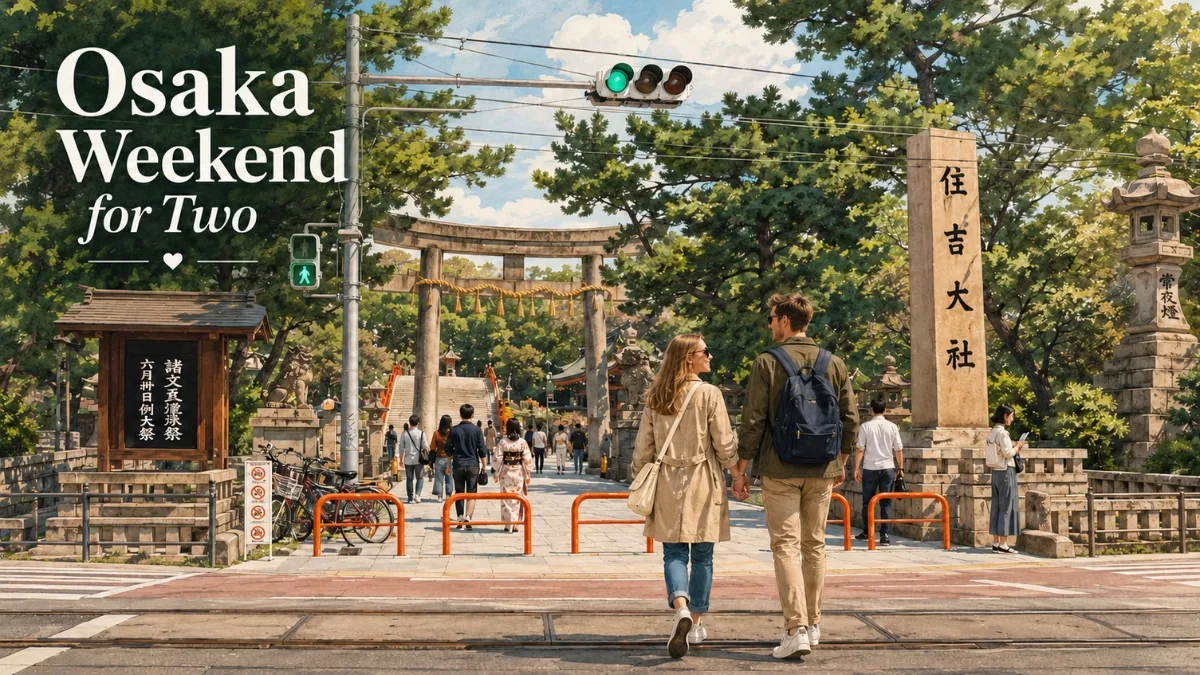
A good Osaka weekend for two should feel connected, not crammed. This plan uses two compact city loops: Osaka Castle, Nakanoshima, and Umeda on day one, then Sumiyoshi Taisha, Namba, Shinsaibashi, Hozenji, and Dotonbori on day two. You get history, riverside space, a skyline, shrine grounds, food, shopping, and an evening walk without treating every hour as a race.
The best base is usually Namba if late dinners and the second day matter most, or Umeda if you arrive through Osaka Station and want the easiest first morning. Reserve one meal you genuinely care about, allow extra time inside large stations, and leave one part of each afternoon adjustable.
| Day | Main route | Best fixed point | Where to keep flexibility |
|---|---|---|---|
| Day 1 | Osaka Castle → Nakanoshima → Umeda | Castle museum entry or sunset observatory | Nakanoshima lunch, cafe, or museum |
| Day 2 | Sumiyoshi Taisha → Namba lunch → Shinsaibashi → Dotonbori and Hozenji | One important dinner | Kuromon versus a sit-down lunch; shopping time |
This is a city itinerary rather than a checklist of Osaka’s biggest attractions. Universal Studios Japan, Kyoto, and a long southern-Osaka excursion each deserve enough time to replace a day, not be added on top.
Choose the base that makes the weekend easier
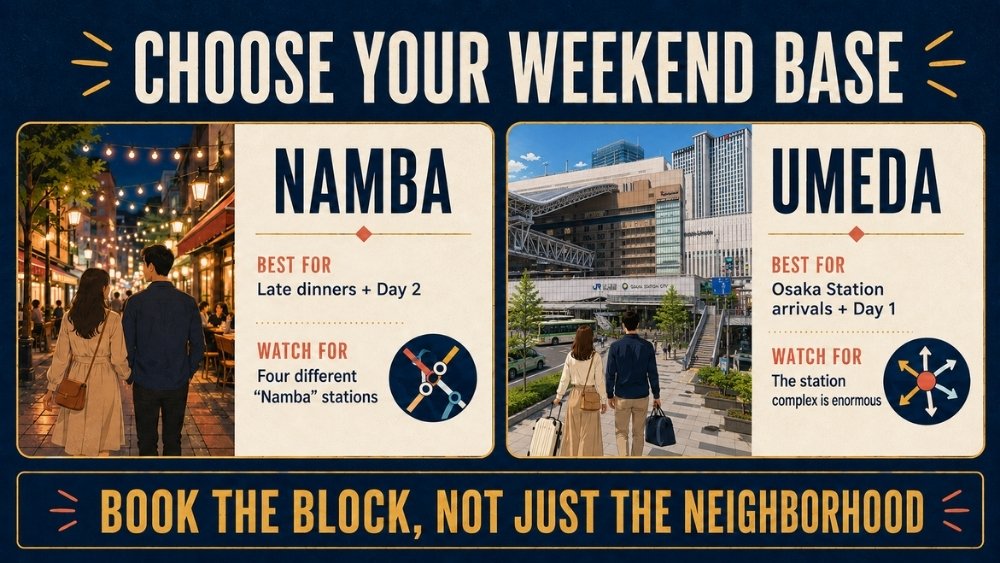
Namba: best for late evenings and day two
Namba keeps Dotonbori, Hozenji, Shinsaibashi, and many dinner choices close to the hotel. It also gives you a direct start for Sumiyoshi Taisha from Nankai Namba Station. The catch is the name: Osaka Metro Namba, Nankai Namba, Osaka-Namba, and JR Namba are separate railway facilities. A hotel that looks “near Namba” may still be inconvenient for the train you intend to use.
Before booking, compare the hotel entrance with the exact station gate on the same map. Use Nankai Namba Station’s official information, Nankai Namba Station on Google Maps, and our guide to staying near Namba Station to test the real walk.
If Namba fits your weekend, compare current Namba hotel prices and availability on Klook. Klook lets you change the displayed language and currency, which can make the first comparison easier in a familiar format. Check the exact address, room category, taxes, cancellation terms, and final stay total before paying.
Umeda: best for Osaka Station arrivals and day one
Umeda works well if your intercity train arrives at JR Osaka Station, if you want department stores and indoor dining nearby, or if an early departure follows the weekend. It is calmer than Dotonbori after dinner, but the Osaka Station–Umeda complex is enormous. “Near Umeda” does not always mean near the JR gate or subway entrance you will actually use.
Open JR Osaka Station’s official information, Osaka Station on Google Maps, and our Osaka Station navigation guide before choosing a block.
If Umeda fits your arrival and departure, compare current Umeda hotel prices and availability on Klook. Recheck the full route from the platform to the property rather than relying only on the distance shown in a hotel listing.
Before the first morning: agree on three things
First, decide which meal matters enough to reserve. One confirmed dinner is usually helpful; booking every meal removes the breathing room that makes a couple’s weekend enjoyable. A table matters more if either traveler dislikes counter seating, wants a quieter conversation, or has dietary needs that require advance discussion.
Second, use an IC card, a rechargeable tap-to-pay transit card such as ICOCA, Suica, or PASMO, for ordinary local trains and subways. It reduces ticket-machine stops, but it does not choose the correct operator, train type, platform direction, or station for you. Read the full station name in the route app before moving.
Third, add a 10- to 15-minute station buffer before a reservation or timed ticket. Osaka Station, Umeda, and Namba can add corridors, wrong exits, and crowds to what looks like a short transfer. Save the destination’s map pin and Japanese address on both phones in case you separate underground.
Day 1: Osaka Castle, Nakanoshima, and Umeda
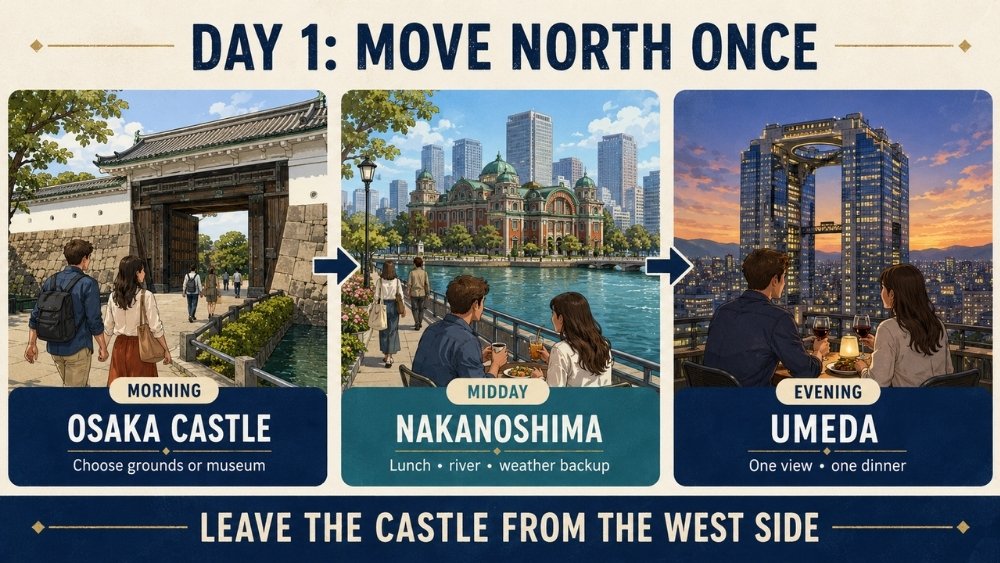
Morning: choose the castle experience before entering the park
Aim to reach Osaka Castle Park in the morning, then choose between two different experiences:
- Grounds-focused visit: walk through Otemon Gate, the moats, stone walls, and open park space. Allow roughly 90 minutes at an easy pace.
- Museum-focused visit: add the paid museum inside the reconstructed main tower. Allow two to three hours for the park and museum together, and expect a busier indoor sequence on weekends.
For the Otemon side, Tanimachi 4-chome Station on the Osaka Metro Tanimachi and Chuo lines is a practical approach. Check the official station page, save Tanimachi 4-chome Station on Google Maps, then save Otemon Gate on Google Maps. If you come from JR Osaka Station, Osakajokoen Station can be simpler by JR Loop Line, but it places you on the eastern side of the park rather than at Otemon. Save Osakajokoen Station on Google Maps. That difference changes the walking route.
The park and the museum are not the same admission decision. Use the Osaka Castle Park site for the grounds and map, and the Osaka Castle Museum site for current exhibitions, admission, and notices. Save Osaka Castle Museum on Google Maps. Recheck current hours and special-event conditions close to the visit rather than building the whole day around an old timetable.
In cherry blossom season, the park can become much busier than this relaxed timing suggests. In summer, start earlier, carry water, and do not underestimate the exposed walks between gates and the main tower.
Midday: make Nakanoshima the recovery stop
Leave the castle from the western side if Nakanoshima is next. This avoids walking back across the park. The exact connection depends on which part of the island you choose, so compare a live transit route with a short taxi; two people may find the taxi worthwhile when heat, rain, or tired feet would turn a simple transfer into another project.
For a light outdoor stop, use the riverside around Osaka City Central Public Hall. The red-brick exterior and nearby paths give you an easy walk without committing to another major attraction. Check the hall’s official site and open Osaka City Central Public Hall on Google Maps.
If a current exhibition appeals to both of you—or if the weather makes a riverside walk unattractive—use the Nakanoshima Museum of Art, Osaka instead. Exhibitions, closing days, admission, and last entry vary, so confirm the museum’s current schedule and save the museum map pin. Do not force the museum into the plan merely because it is indoors; a long lunch and cafe break can be the better choice after a full castle visit.
Evening: give Umeda one view and one dinner
Move north to Umeda after the break. Choose one destination before entering the station complex. Browsing every underground passage, department store, and dining floor is not a realistic romantic plan when both people are already tired.
For a skyline view, Kuchu Teien Observatory at Umeda Sky Building offers indoor levels and an open-air rooftop. The official access route from JR Osaka Station includes several turns and an underground walkway, so allow more time than a map’s straight-line distance suggests. Check current hours, weather notices, and access on the official site, and save Umeda Sky Building on Google Maps. The rooftop may close in heavy rain even when indoor areas remain available.
If the observatory is a fixed part of the evening, compare the current Umeda Sky Building ticket options on Klook after checking the official operating notice. Choose the exact package you intend to use and read its date, cancellation, and voucher conditions before checkout.
For sunset, arrive while there is still daylight rather than timing the gate to the exact published sunset minute. Weather, entry flow, lifts, and the walk from Osaka Station all add uncertainty. If visibility is poor, skip the paid view and keep the evening for dinner.
Book the night’s one important table in Umeda, or eat early and keep several nearby alternatives. After dinner, the Osaka Metro Midosuji Line connects Umeda and Namba directly, but trains can be busy during evening periods.
Day 2: Sumiyoshi Taisha, Namba, and a one-way evening walk
Morning: take the correct Nankai train to Sumiyoshi Taisha
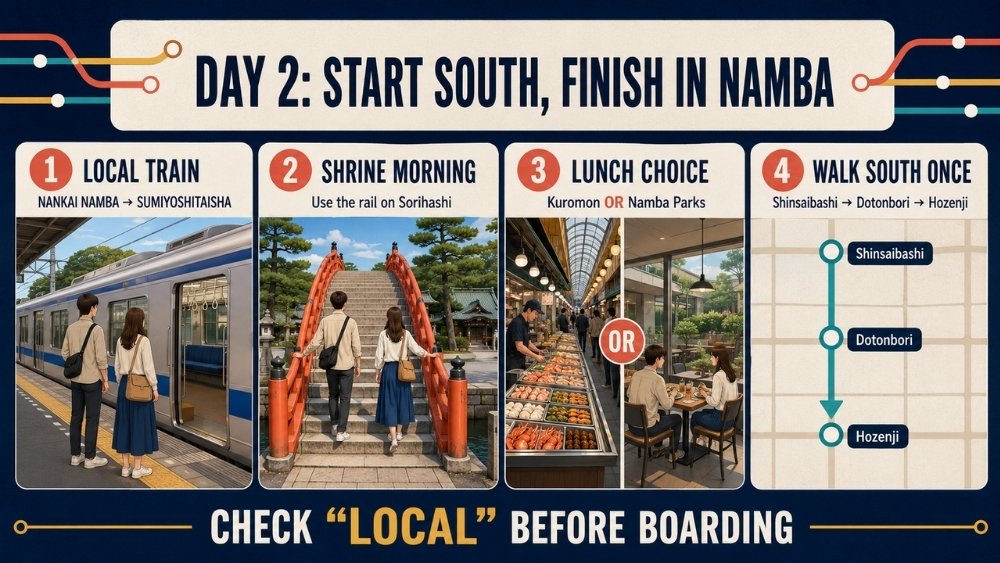
From Nankai Namba Station, take a Nankai Line Local train to Sumiyoshitaisha Station. The operator’s current station page lists Local as the stopping train type, so do not board a faster-looking service without checking the departure board. Use Nankai’s Sumiyoshitaisha Station page for current station and timetable access, and save Sumiyoshitaisha Station on Google Maps.
At the shrine, the vermilion Sorihashi Bridge is genuinely steep: the shrine describes a slope of more than 40 degrees at its steepest point. Use the railings, slow down after rain, and do not block the bridge for photographs. The bridge is part of a religious site, not a photo prop. If either traveler is uncomfortable with the slope, do not pressure them to cross it; consult the precinct map and staff for the most suitable route around the grounds.
Allow about 60 to 90 minutes for the main precinct at an unhurried pace. Follow posted worship and photography guidance, keep voices low near prayer areas, and treat charms and amulets as religious items rather than ordinary souvenirs. Use the Sumiyoshi Taisha official site and precinct map, and save Sumiyoshi Taisha on Google Maps.
Lunch: choose Kuromon for variety or Namba Parks for a proper rest
Return by Local train to Nankai Namba. Then choose lunch based on energy, not fame.
Kuromon Ichiba Market works when you want to share several small items and do not mind standing, queues, and variable shop hours. It is a market of independent businesses rather than one restaurant with one schedule. The official information center asks visitors not to stop in the middle of the passage and provides a designated rest area where food and drink are allowed. Check the Kuromon official directory and shop hours, the market information-center guidance, and Kuromon Market on Google Maps. Prices vary by stall; look before ordering rather than assuming every display is a bargain.
Namba Parks is the better fallback when you want seats, air conditioning, toilets, and a longer conversation. Restaurants keep their own hours, so choose a floor and restaurant before wandering the entire complex. Use the Namba Parks official directory and Namba Parks on Google Maps.
Carry some cash even if you normally pay by card. Central Osaka is widely card-friendly, but a small market stall or older restaurant may use a different payment setup. For food allergies or a strict diet, a sit-down restaurant that can discuss ingredients is usually safer than improvising through several stalls; Japanese stock can contain fish even when no meat is visible.
Afternoon to evening: start north, then walk south once
The simplest low-backtracking version is to begin the shopping portion at Shinsaibashi and walk south toward Namba. From Namba, take the Midosuji Line one stop to Shinsaibashi, or walk north if both of you still want the extra distance.
Follow Shinsaibashi-suji Shopping Street south. The covered arcade helps in rain and strong sun, but each shop sets its own hours. You do not need to complete every store. Check the shopping street association’s official site and open Shinsaibashi-suji Shopping Street on Google Maps.
The arcade leads toward Ebisubashi and Dotonbori. Arrive around dusk if you want both the changing light and illuminated signs, but expect weekend crowd density to rise in the evening. Cross the canal once, choose one riverside direction, and continue toward the next stop instead of repeatedly doubling back through the busiest bridge area. Use the Dotonbori Shopping District official site and Ebisubashi on Google Maps.
Finish the walk at Hozenji Temple and Hozenji Yokocho, a compact temple-and-alley area just south of the canal. It is atmospheric after dark, but it remains a place of worship surrounded by working restaurants. Keep the temple approach clear, follow posted photography guidance, and do not stage a long shoot in the narrow lane. Check Osaka Metro’s current Hozenji listing and save Hozenji Temple on Google Maps.
For dinner, move one or two blocks away from the brightest canal frontage if queues and noise are high. Takoyaki is easy to share as a snack, but most travelers will still want a proper meal. Avoid eating while walking through a dense arcade; step aside at the shop’s designated area or sit down.
Adjust the plan without breaking the weekend
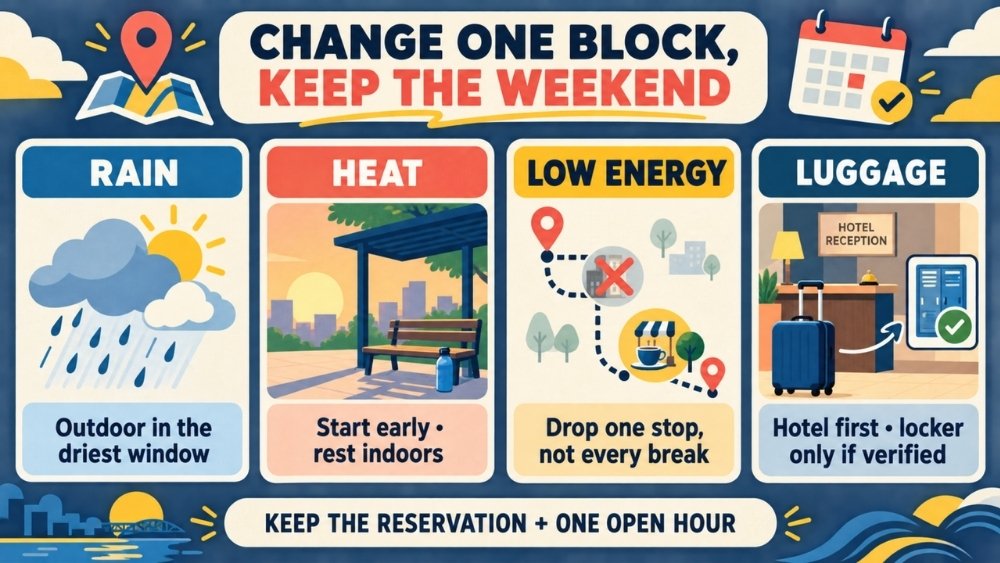
If it rains
Put Osaka Castle Park and Sumiyoshi Taisha into the driest forecast windows. Use the Nakanoshima museum, Umeda’s indoor commercial areas, Namba Parks, or the covered Shinsaibashi arcade for the wettest period. Heavy rain can close the open-air roof at Umeda Sky Building, so check the operator before traveling there only for the rooftop.
If it is extremely hot
Move both outdoor starts earlier, carry water, and make the middle of each day a genuine indoor rest. The castle grounds are larger and more exposed than the main-tower pin suggests. Sumiyoshi and Namba can also feel tiring when a short train ride is followed by long shopping streets.
If one person is tired or dislikes crowds
Drop a stop rather than making both people hurry. On day one, choose either a longer castle visit or a Nakanoshima museum, not both. On day two, choose Kuromon or Namba Parks, then shorten Shinsaibashi and approach Dotonbori later. A cafe near the hotel may create a better shared memory than one more famous pin.
If you have luggage
Do not carry large bags through this itinerary. Leave them at the hotel or use a verified station locker only after checking size and availability. Saving a locker area in a route app does not reserve a locker, and returning to the wrong side of a large station can erase the time you thought you saved.
The small checks that protect the good parts
Before each morning, save the exact railway operator, station name, destination pin, and one weather backup. Before the reserved meal or ticket, confirm the date, last-entry or arrival condition, and route from the correct station—not merely the neighborhood name.
Most importantly, protect one unscheduled hour. Osaka is better when there is room to notice a riverside bench, stay over coffee, or choose the restaurant that suits both of you in that moment. The fixed points keep the weekend moving; the open space is what lets it feel like your own.