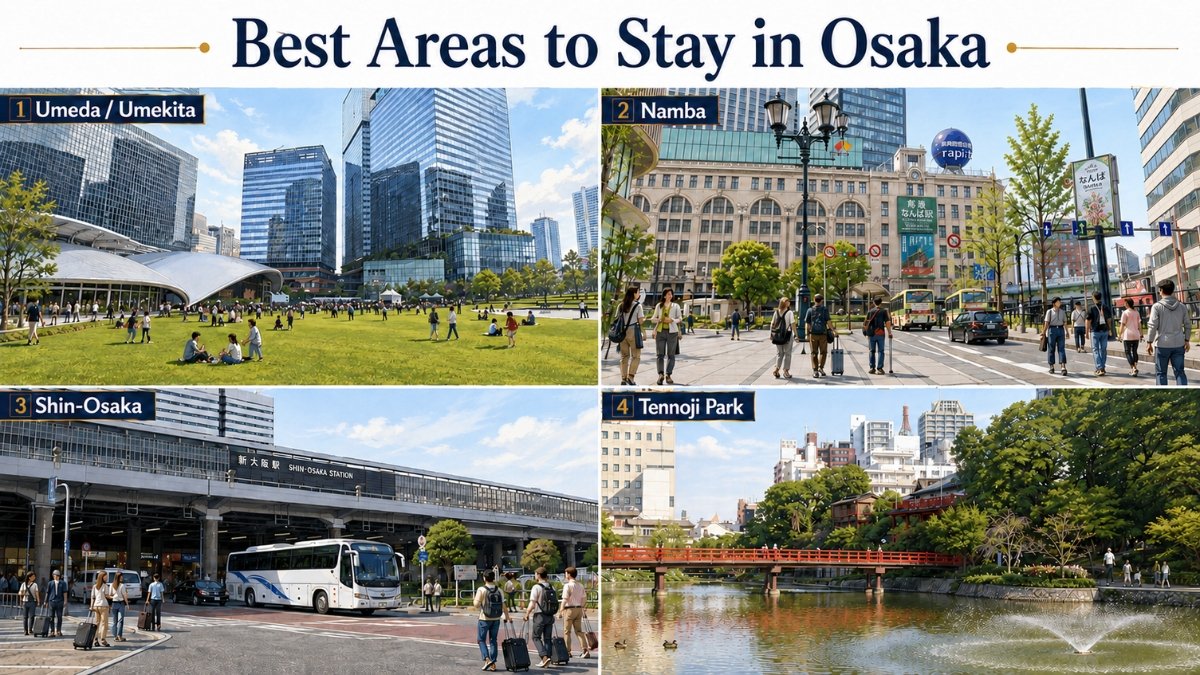
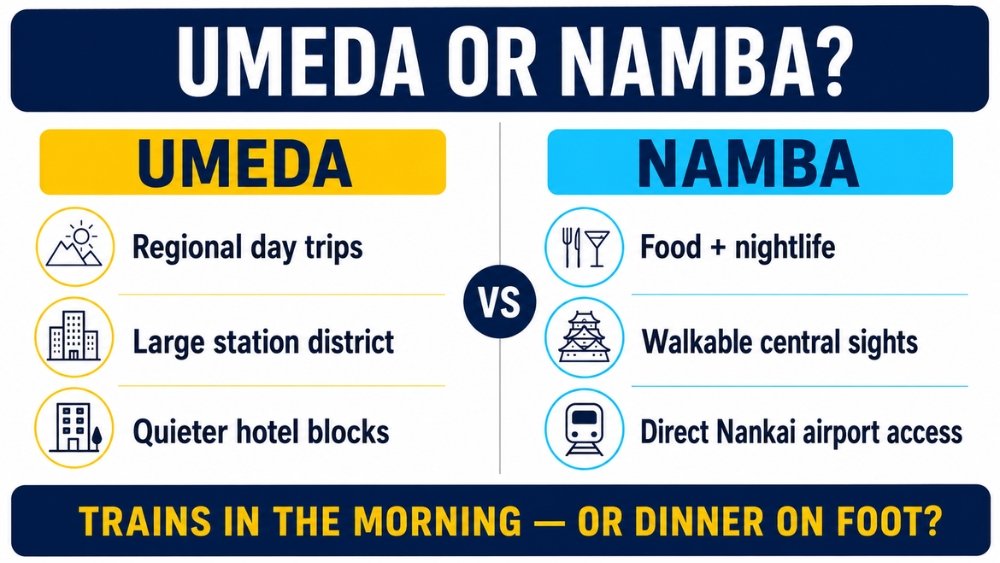
For most first-time visitors, Umeda and Namba are the two strongest places to stay in Osaka.
- Choose Umeda when easy regional day trips, department stores, and broad rail connections matter most.
- Choose Namba when you want restaurants, shopping, and Dotonbori within walking distance after dark.
- Choose Shin-Osaka when an early or late Shinkansen is the main reason for your location.
- Choose Tennoji when you want a well-connected southern base with less pressure than the busiest parts of Namba.
The right answer is not simply “closest to the center.” It is the area that makes your arrival, evenings, day trips, and final departure easier.
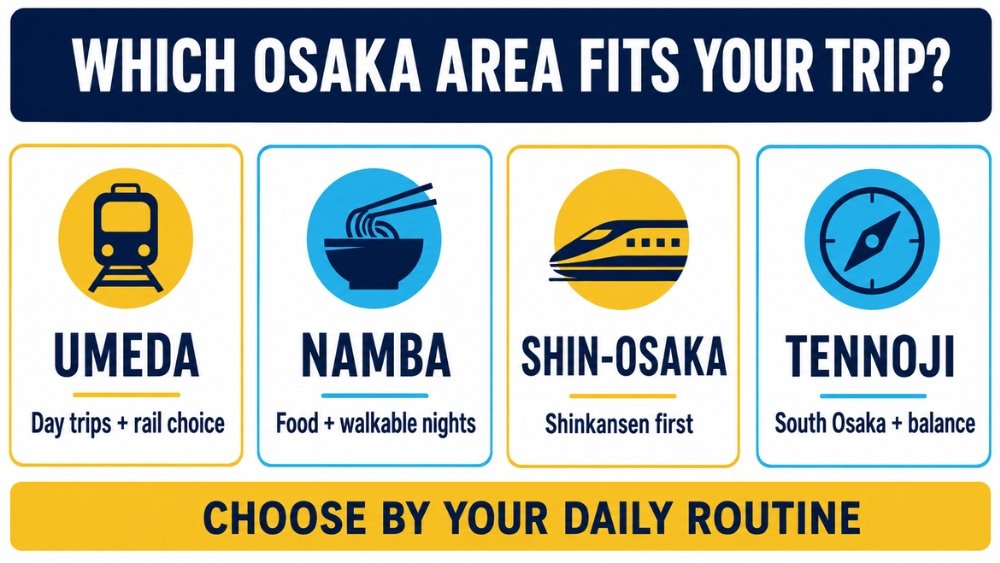
Osaka hotel areas at a glance
| Area | Best for | Airport logic | Evening style | Main trade-off |
|---|---|---|---|---|
| Umeda | Regional day trips and broad transport choice | JR or airport-bus options, depending on the hotel | Department stores, restaurants, and high-rise city views | The station complex takes time to learn |
| Namba | Food, nightlife, and walkable central sightseeing | Direct Nankai access from Kansai Airport | Busy streets, late meals, and shopping | Noise and crowds vary sharply by block |
| Shin-Osaka | Shinkansen-focused travel days | Rail connection available, but not the simplest base for every itinerary | Functional and quiet | Limited sightseeing atmosphere outside the station area |
| Tennoji | South Osaka access, families, and a lower-pressure base | Direct JR airport access | Shopping, parks, and local dining | Less convenient for walking to Umeda or Dotonbori |
This table is an editorial decision guide, not a promise about every hotel. Always check the exact property entrance, station gate, walking route, and current transport timetable.
Umeda: best all-round base for day trips
Umeda is the northern city center around JR Osaka Station, Osaka-Umeda Station, and the Osaka Metro stations named Umeda, Higashi-Umeda, and Nishi-Umeda.
It is the strongest all-round choice when your trip includes several regional journeys. JR trains are useful for Kyoto, Kobe, Himeji, Universal City, and connections at Shin-Osaka. Hankyu and Hanshin add private-railway options toward Kyoto and Kobe, while Osaka Metro connects Umeda with central Osaka.
Who should choose Umeda?
Umeda suits:
- first-time visitors taking several day trips;
- travelers who prefer large shopping and dining complexes;
- couples or families who want an active center without sleeping beside Dotonbori;
- visitors who want several rail operators within one district.
It is less suitable if your main goal is stepping outside the hotel and immediately walking through Osaka’s best-known food and nightlife streets.
The main Umeda mistake
Do not treat every station with “Umeda” or “Osaka” in its name as one set of platforms. JR, Hankyu, Hanshin, and Osaka Metro have separate gates and concourses. The official JR Osaka Station map shows how extensive the station has become.
A hotel advertised as “Umeda” may still require a long underground walk. Check the route from the exact station gate you expect to use—not only the straight-line distance on a map. The Osaka Station navigation guide provides a more detailed first-arrival plan.
After checking the walking route, compare current Umeda hotel options on Klook.
Namba: best for food, nightlife, and walking
Namba is the southern city center around Nankai Namba, Osaka Metro Namba, Osaka-Namba, and JR Namba. These are connected as a district, but they are not one simple station.
Namba works especially well when the evening is part of the trip. Dotonbori, Shinsaibashi, Nippombashi, and many restaurant streets can be reached on foot from a correctly located hotel. The Osaka Metro Midosuji Line also connects Namba directly with Umeda, Shin-Osaka, and Tennoji.
Who should choose Namba?
Namba suits:
- travelers who want dinner and nightlife close to the hotel;
- short Osaka-focused trips with limited regional travel;
- visitors arriving through Kansai International Airport who value Nankai access;
- travelers who prefer street-level atmosphere to large station buildings.
Nankai’s current airport service connects Kansai Airport and Namba. Recheck the official Nankai airport information for the timetable, ticket type, and service status that fit your arrival.
The main Namba mistake
Do not book directly beside Dotonbori only because it looks central. One block can be lively late at night while another is much quieter. Check the actual nearest station, street noise, room access, and whether you can comfortably roll luggage along the route.
“Namba” also covers a wide area. A hotel near JR Namba may suit a bus-terminal arrival but feel less immediate for Nankai airport trains. A hotel south of Nankai Namba may be practical for the airport but farther from Shinsaibashi. Read the address and map before comparing room photos.
After choosing the part of Namba you actually want, compare current Namba hotel options on Klook.
Shin-Osaka: best when the Shinkansen controls the schedule
Shin-Osaka is north of the main sightseeing districts. It is Osaka’s Shinkansen station and also has JR conventional lines and the Osaka Metro Midosuji Line.
Staying here makes sense when:
- you have an early Shinkansen departure;
- you arrive late by Shinkansen with heavy luggage;
- several long-distance rail journeys dominate the itinerary;
- the stay is only one night before or after a travel day.
The official Shin-Osaka Station map shows separate Shinkansen, conventional-line, subway, bus, and commercial areas. A hotel close to the station still needs an exit check because the complex is large.
Why most first-time visitors should not default to Shin-Osaka
Shin-Osaka is efficient rather than atmospheric. You will normally travel to Umeda, Namba, Tennoji, or another district for major sightseeing and evenings. If your itinerary contains only one Shinkansen journey, Umeda may provide a better balance between city experience and onward rail access.
Do not confuse Shin-Osaka with Osaka Station. They are separate stations. The Shin-Osaka versus Osaka Station guide explains which one serves each travel purpose.
If the Shinkansen genuinely controls your stay, compare current Shin-Osaka hotel options on Klook.
Tennoji: best alternative for south Osaka and families
Tennoji combines JR, Osaka Metro, and nearby Kintetsu services around Tennoji Station and Osaka-Abenobashi Station. The Midosuji Line provides a direct connection to Namba, Umeda, and Shin-Osaka, while JR routes serve Kansai Airport and destinations south and east of central Osaka.
The area has major shopping buildings, restaurants, Tennoji Park, and more open space than the streets around Dotonbori. It can suit families and travelers who want a central base without placing nightlife at the hotel door.
Who should choose Tennoji?
Tennoji suits:
- families who value parks, shopping buildings, and direct subway access;
- travelers using JR airport services;
- visitors planning south-Osaka or Nara-area journeys;
- travelers who find central Namba prices or noise unsuitable.
It is less suitable if most evenings are in Umeda or if walking to Dotonbori is essential. The Midosuji Line is direct, but you will still travel between districts.
The official Osaka Metro Tennoji page identifies the current subway station layout and connections.
Compare current Tennoji hotel options on Klook after checking whether the property is closer to JR Tennoji, Osaka Metro, or Osaka-Abenobashi.
Choose by arrival route
Your arrival day can make one area easier than another.
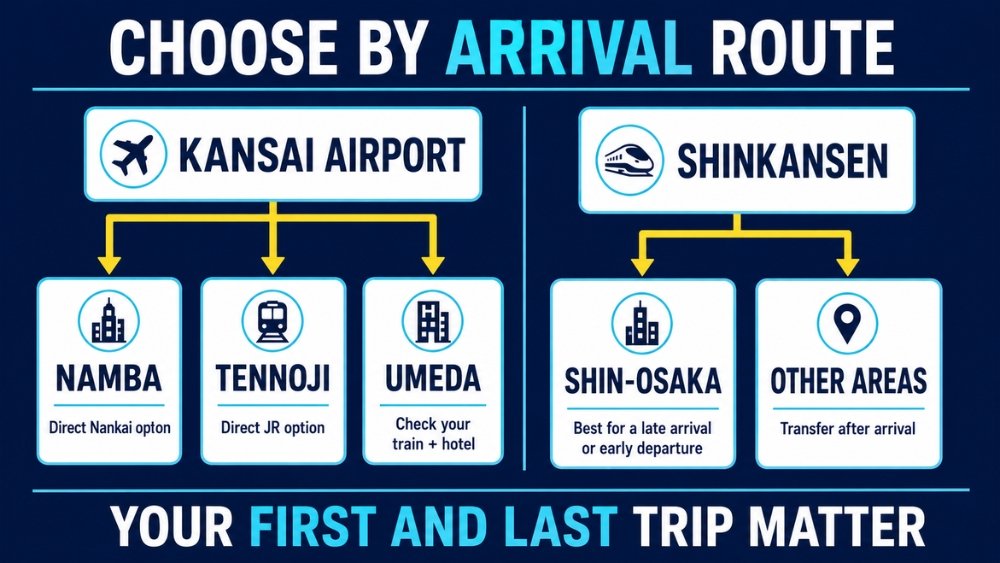
From Kansai International Airport
- Namba: strongest when you want direct Nankai access and a walkable evening district.
- Tennoji: practical when your preferred JR airport service matches the hotel location.
- Umeda: useful for northern Osaka and onward regional travel; choose between current JR and airport-bus options based on the hotel.
- Shin-Osaka: useful when the next major journey is by Shinkansen, but check whether a direct airport service or a transfer fits your arrival time.
The Kansai Airport to Osaka guide compares the main destination-based choices. Recheck current operator timetables before travel.
From Tokyo or another Shinkansen city
Shin-Osaka is the arrival station. Staying there minimizes the first luggage transfer, but the better full-stay location may still be Umeda, Namba, or Tennoji. Consider a one-night Shin-Osaka stay only when the arrival or departure time makes the transfer inconvenient.
Choose by your evenings and day trips
Stay in Umeda when the day starts with a train
Choose Umeda when several mornings begin with regional rail. The district reduces friction for Kyoto, Kobe, Himeji, and other north- or westbound travel, depending on the operator and destination.
Stay in Namba when the day ends on foot
Choose Namba when late meals, shopping, and street-level evenings matter more than the simplest regional connections. Walking back to the hotel can be valuable after the last planned stop.
Stay in Shin-Osaka when one train cannot be missed
Choose Shin-Osaka for an early reserved departure, a late arrival, or repeated Shinkansen use. Do not choose it only because the station name sounds central.
Stay in Tennoji when you want balance in the south
Choose Tennoji when you want strong local transport, airport access, shopping, parks, and a more relaxed base than central Namba.
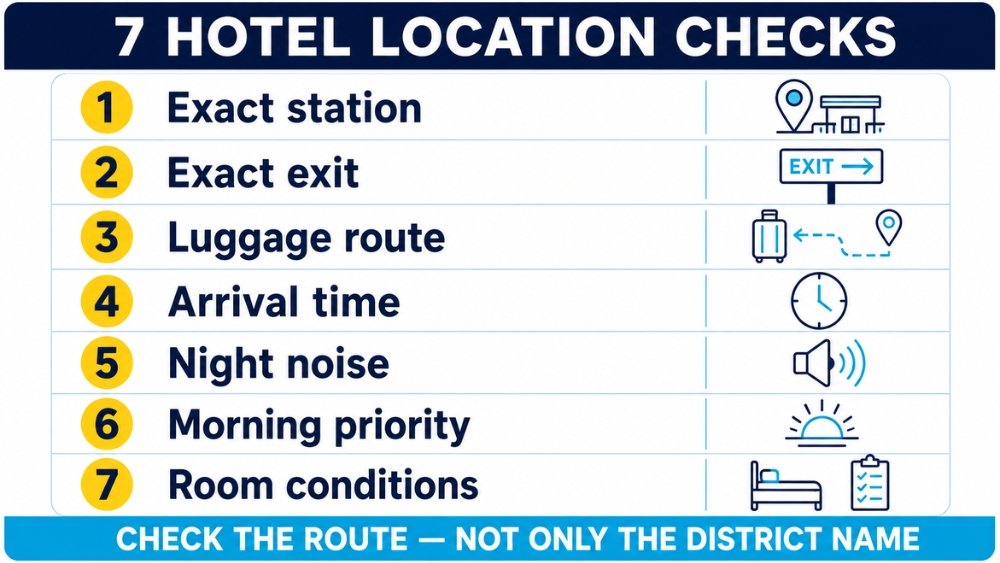
Seven checks before booking any Osaka hotel
- Exact station: Identify the operator and station, not only the district name.
- Exact exit: Check the walking route from the gate or exit you expect to use.
- Luggage route: Look for stairs, pedestrian bridges, long underground passages, and uneven streets.
- Arrival time: Confirm whether reception, luggage storage, and transport still work when you arrive.
- Evening noise: Check the block, not only the neighborhood label.
- Morning priority: Decide whether your first trip is toward a day-trip train, airport, or city attraction.
- Room conditions: Verify occupancy, bed setup, breakfast inclusion, cancellation terms, and any child policy before paying.
Final verdict
For a first Osaka trip, choose Umeda as the safest all-round base when regional transport matters most. Choose Namba when food, nightlife, and walking shape the trip. Use Shin-Osaka only when Shinkansen timing clearly justifies it, and choose Tennoji when you want a connected southern base with more breathing room.
After choosing the area—not before—use Klook to compare hotels by the exact station entrance and walking route you plan to use.
Transport patterns, hotel access, prices, and operating conditions can change. Recheck the relevant first-party transport page and the hotel’s own conditions before completing the booking.