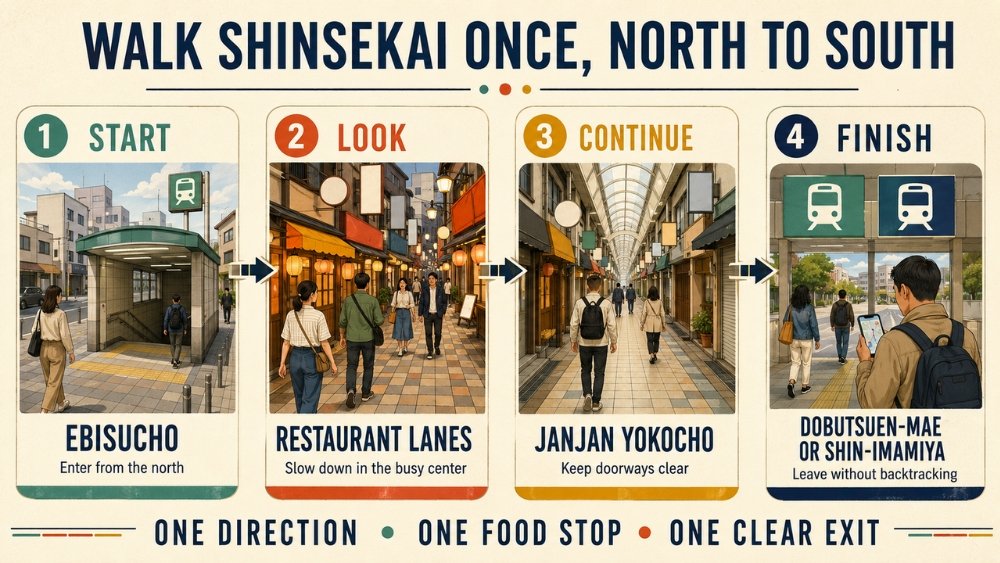
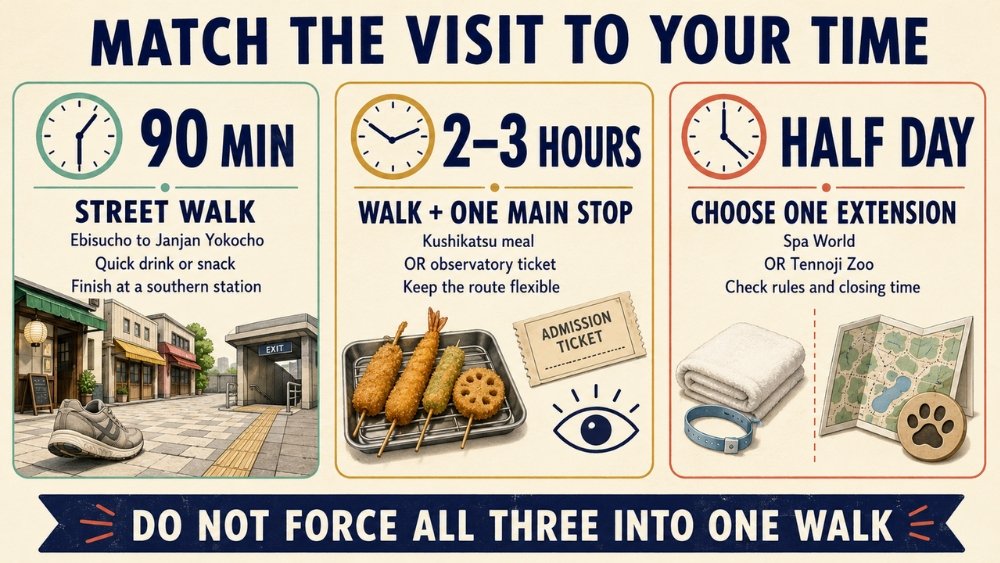
Shinsekai is best treated as a compact street walk, not a full day of sightseeing. For a first visit, allow about 90 minutes for the neighborhood itself or two to three hours if you add one meal or one paid attraction. Enter from the north at Ebisucho, walk through the central restaurant streets, continue through Janjan Yokocho, and finish near Dobutsuen-mae or Shin-Imamiya. That one-way route shows the famous, crowded side of Shinsekai and its narrower old shopping lanes without unnecessary backtracking.
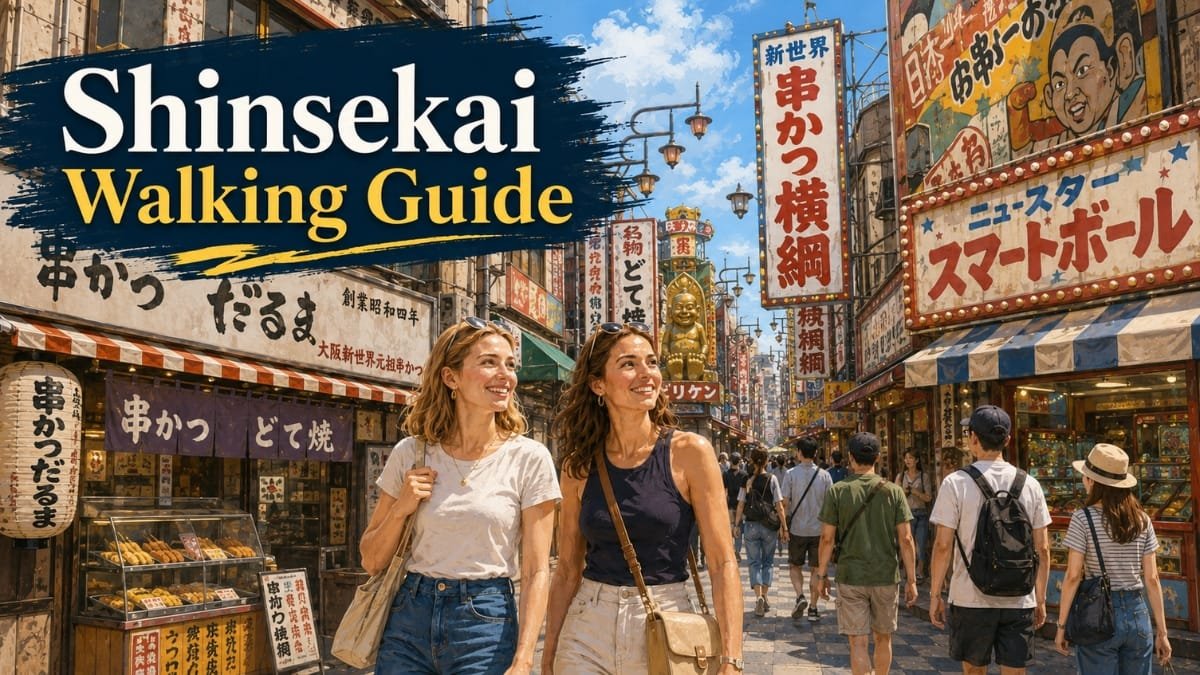
The district is in southern Osaka beside Tennoji. Its identity comes from bright restaurant fronts, kushikatsu shops, game arcades, older low-rise streets and Tsutenkaku. The atmosphere is nostalgic and busy rather than polished. Visitors who expect a large theme district may find it smaller than imagined; visitors who come for one meal and a slow look at the streets usually understand it better.
| Time available | Sensible plan | Where to finish |
|---|---|---|
| 60–90 minutes | One-way street walk with a quick drink or snack | Dobutsuen-mae or Shin-Imamiya |
| 2–3 hours | Street walk plus kushikatsu or one paid attraction | The station closest to that final stop |
| Half a day | Street walk plus one of Tsutenkaku, Spa World or Tennoji Zoo | Dobutsuen-mae, Shin-Imamiya or Tennoji |
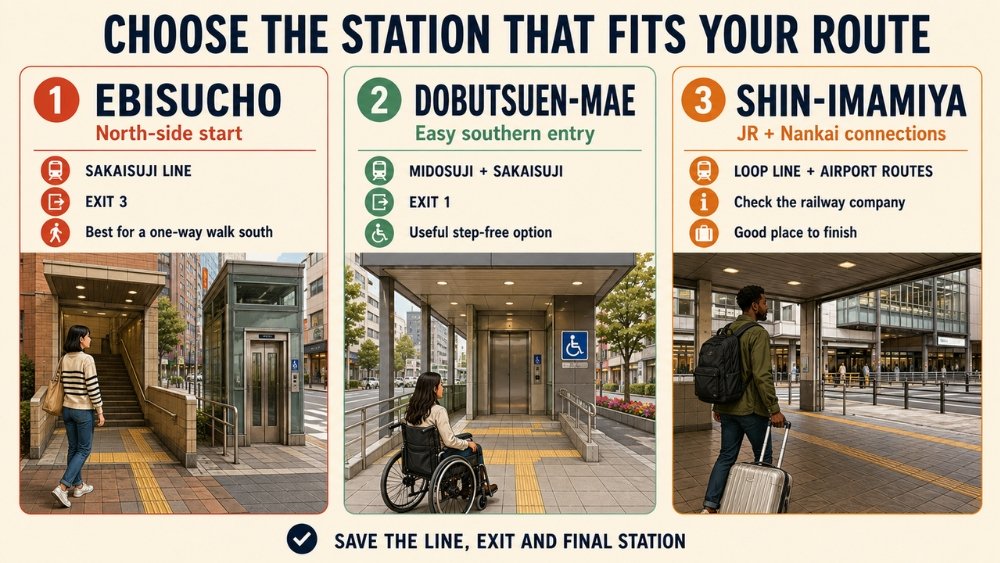
Choose the station that matches your route
Shinsekai has three useful rail approaches. The easiest station is not the same for every traveler, so save the line, exit and final station before you start walking.
Ebisucho: best for a north-to-south walk
Use Ebisucho Station on the Osaka Metro Sakaisuji Line if you want to begin on the north side. Ebisucho Station on Google Maps is close to the northern entrance to Shinsekai; the official Tsutenkaku access guide gives a walk of about three minutes from Exit 3.
This is the cleanest start for the route in this guide because you can keep moving south. However, do not assume the nearest exit suits every mobility need. Tennoji Zoo specifically warns that the south ticket gate nearest Ebisucho Exit 3 has no elevator. If you need a step-free route that avoids stairs, use the live station map and consider Dobutsuen-mae instead.
Dobutsuen-mae: best from the Midosuji Line
Dobutsuen-mae Station is served by the Midosuji and Sakaisuji lines. It is convenient from Umeda, Namba or Tennoji and puts you near the southern side of Shinsekai. Save Dobutsuen-mae Station on Google Maps, then use the official exit map for the side you need. Exit 1 is the approach named by both Tsutenkaku and Tennoji Zoo.
Choose this station if you want the simplest subway ride, need the elevator route recommended by the zoo, or prefer to walk south to north. It is also a practical exit after Janjan Yokocho.
Shin-Imamiya: best for JR, Nankai and airport connections
Shin-Imamiya Station is useful for JR (Japan Railways) Osaka Loop Line passengers and Nankai private-railway travelers, including people connecting toward Kansai Airport. Shin-Imamiya Station on Google Maps is south-west of the main Shinsekai streets. JR and Nankai use different gates, so confirm the railway company as well as the station name.
If Shinsekai is part of a larger southern Osaka day, our Namba vs Tennoji guide explains how the nearby transport hubs differ. Large luggage should stay at your hotel or in a suitable locker; narrow arcades and busy restaurant lanes are much easier with a small bag.
Walk Shinsekai once, from north to south
The useful route is short. Do not measure the visit by how many side streets you can collect. Move through four clear stages and stop where your interests justify the time.
1. Enter from Ebisucho
From Ebisucho Exit 3, walk toward the district rather than circling the station. The streets quickly change from ordinary city blocks to denser restaurant fronts, lanterns and entertainment signs. This transition is part of the experience, so keep the first ten minutes unhurried.
2. Use Tsutenkaku as the central decision point
Tsutenkaku is the district’s main landmark and a useful place to reorient. Tsutenkaku on Google Maps sits among the most photographed restaurant streets. Walk around the surrounding blocks even if you do not enter the observatory.
Going up is optional. As checked in August 2026, the official operating guide lists the general observatory from 9:00 to 21:45, with last entry at 21:15. It also says a timed entry reservation is required when buying tickets and warns that later slots can sell out. General admission is listed as ¥1,500 for ages 15 and older and ¥800 for ages 5–14. Recheck the official page on the day because hours, prices and closures can change.
If you prefer to arrange a mobile ticket before the walk, compare current Tsutenkaku admission options on Klook. Klook lets you switch the displayed language and currency, which can make inclusions and the final amount easier to compare. Confirm the selected package, entry time, cancellation terms and whether any slide or outdoor experience is separate.
3. Continue through the restaurant lanes
Move south through the central streets instead of returning to Ebisucho. This is the most visually intense part of the walk, with large shopfront displays, queues, music and people stopping for photographs. Step to the side before checking a map or taking a group photo. Restaurant entrances and the central pedestrian flow must remain clear.
Late morning is useful if you want a quieter look while restaurants are beginning service. Lunch and early evening have more energy but also more queues. Do not rely on one district-wide opening time: every business controls its own hours and closing days.
4. Finish in Janjan Yokocho
Janjan Yokocho is a narrow covered shopping lane on the southern side of Shinsekai. Osaka City describes it as an old-style arcade with eateries, kushikatsu shops, and go and shogi businesses. Save Janjan Yokocho on Google Maps before entering because the covered lane can make your position less obvious.
Walk through without blocking doorways, then exit toward Dobutsuen-mae or Shin-Imamiya. This gives the route a real ending. If you turn around at every point, a compact neighborhood starts to feel repetitive.
Make one food stop instead of grazing at every sign
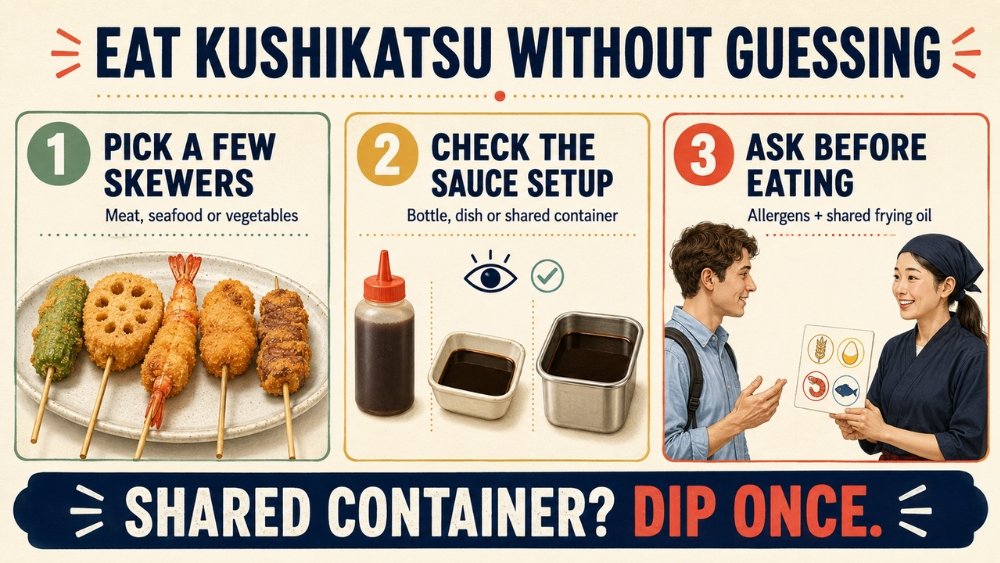
Kushikatsu means pieces of meat, seafood or vegetables on skewers, coated and deep-fried. It is closely associated with Shinsekai, but shops are not interchangeable. Compare the queue, seating, payment method, allergen information and ordering rules—not only the size of the sign outside.
A classic counter: Ganso Kushikatsu Daruma Shinsekai Main Store
Ganso Kushikatsu Daruma Shinsekai Main Store is the original chain’s compact main shop at 2-3-9 Ebisu Higashi. Open it on Google Maps rather than following a pin for another branch.
The official store page lists 12 counter seats, no reservations and cash-only payment. It also lists a one-drink-per-person requirement, except for children of primary-school age and younger. Current hours are shown as 11:00–22:30 on weekdays and 10:30–22:30 on weekends and holidays, with last orders 30 minutes before closing. These conditions make it a focused stop for a small group, not the most practical choice for a large party that needs adjacent seats.
Sauce service has changed at many kushikatsu shops, so the old advice that every table has one shared container is no longer reliable. Look at the setup in front of you and follow that shop’s instructions. If a shared container is present, dip only once. If sauce comes in a bottle or individual dish, use it as directed. For allergies, do not assume that a vegetable skewer is isolated from meat, seafood, wheat, egg or shared frying oil; check the restaurant’s official allergen information and ask staff before ordering.
A seated coffee break: Sennariya Coffee
Sennariya Coffee is a useful alternative when the group wants a seat and a non-fried break. The cafe says it was founded in Janjan Yokocho in 1948 and is the birthplace of mixed juice, a sweet blended fruit-and-milk drink familiar in Osaka. Sennariya Coffee on Google Maps is inside the southern arcade.
The official site lists 34 seats and current hours of 11:30–19:00 on weekdays and 9:00–19:00 on weekends and holidays. Check the site before making it a fixed breakfast or evening stop. Mixed juice may contain dairy and other ingredients that matter for allergies, so ask rather than inferring from the English name.
If choosing restaurants, understanding menus or handling dietary questions feels more important than walking independently, compare current Shinsekai food tours on Klook. Check the number of tastings, drinks, meeting point, total walking time, dietary policy, group size and cancellation terms; a guided tour is a different product from a casual self-guided snack stop.
Add only one paid extension
The central walk is compact enough to pair with another place, but adding all three options below creates a rushed day. Choose the extension that solves one clear goal.
Tsutenkaku for a city view
Choose Tsutenkaku if the observatory itself matters, not simply because the building appears in photographs. A timed reservation adds structure to the day, and queues or elevator movement can take longer than the street walk suggests. The official site has no visitor parking, so rail access is the practical default.
This is the smallest extension geographically. It suits a visitor with two to three hours who wants both the streets and a paid viewpoint. Travelers uncomfortable with heights or tight indoor queues can enjoy the neighborhood without entering.
Spa World for a long indoor break
Spa World is a large hot-spring and leisure complex beside the southern edge of Shinsekai. Spa World on Google Maps is close to Dobutsuen-mae and Shin-Imamiya, making it a natural final stop rather than a pause in the middle of the walk.
As checked in August 2026, the official pricing page lists general entry at ¥1,500 for junior-high-school age and older and ¥1,000 for elementary-school age and younger, with towels, shampoo and indoor clothing included. Special-date prices can differ. The stone sauna, pool attractions and other services may cost extra. The facility’s rules prohibit people with tattoos, including tattoo ink and seals, and prohibit entry to the bathing areas while under the influence of alcohol. Public bathing is nude and separated by the facility’s rules, so this option only works if everyone understands and accepts the bathing format.
Confirm what the ticket covers, the selected date, pool or sauna supplements, tattoo policy and cancellation terms.
Tennoji Zoo for families and a daytime half-day
Tennoji Zoo is a better extension for families who want open-air animal exhibits and a longer daytime activity. Tennoji Zoo on Google Maps has a Shinsekai Gate on the side nearest this walk.
The zoo currently lists 9:30–17:00 opening and last entry at 16:00. Admission is ¥800 for adults and ¥200 for elementary and junior-high-school students; preschool children are free. Eligible Osaka City students are also free with the required original proof. It normally closes on Mondays, the next weekday when Monday is a national holiday, and from December 29 to January 1. Recheck the official calendar because seasonal events and temporary changes can affect access.
The zoo estimates five to ten minutes on foot from Dobutsuen-mae Exit 1, Ebisucho Exit 3, JR Shin-Imamiya’s East/Tsutenkaku exit or Nankai Shin-Imamiya’s North exit, but ten to fifteen minutes when using an elevator route. If an advance QR ticket is useful, compare current Tennoji Zoo admission options on Klook and check ticket validity, child categories, cancellation rules and the official closure calendar before paying.
Match the visit to your comfort level
Shinsekai is colorful, nostalgic, noisy and visibly older than newer parts of Umeda or Namba. Some streets have smoking, alcohol-focused businesses or adult-oriented venues. None of that requires alarm, but it does make late morning through early evening the easiest first window for families, older travelers and anyone who dislikes heavy nightlife.
Solo travelers and couples can cover the route easily because every decision is reversible: skip a queue, choose coffee instead of kushikatsu, or leave from the next station. Families should keep the street walk short and let the zoo or another child-focused stop provide the longer part of the day. Wheelchair users and travelers with strollers should choose exits from the official station maps and avoid treating the shortest staircase as the best route.
Much of the experience is outdoors or in arcades that are not fully climate-controlled. In summer, arrive earlier, carry water and schedule an indoor break. In heavy rain, the covered lanes help, but the connections between stations, streets and attractions still involve exposed sections. Comfortable shoes matter more than a complicated route.
Photography is part of the appeal, but these are working streets. Do not photograph people closely without permission, point a camera into a small business, block a restaurant entrance or stand in the center of Janjan Yokocho. Ask before photographing inside.
Leave before the walk becomes repetitive
A good Shinsekai visit ends with a clear exit. For the core route, continue through Janjan Yokocho to Dobutsuen-mae or Shin-Imamiya. If you choose Spa World, finish there. If you choose Tennoji Zoo, continue toward Tennoji Park and the Tennoji station area. If you enter Tsutenkaku, use the booked time as the anchor and keep the rest of the walk flexible.
The essential experience is simple: arrive at the station that fits your line, walk one direction through the street-level district, make one deliberate food choice and add no more than one major extension. That is enough to see what makes Shinsekai distinct without turning a compact neighborhood into a checklist.