For the simplest visit, take a Nankai local train from Nankai Namba Station to Sumiyoshitaisha Station. Nankai lists the ride at about 10 minutes, and only local trains stop at Sumiyoshitaisha. From Tennoji or Abeno, the Hankai tram to Sumiyoshitoriimae is slower but more atmospheric and stops beside the shrine approach.
Allow about an hour for an unhurried first visit. Go earlier in the day if you want a quieter bridge and easier photos, and allow much more time around New Year or major festival dates. Admission is free. Check the official Sumiyoshi Taisha website before a special trip because hours and event conditions can change.
Choose the route that fits where you are starting
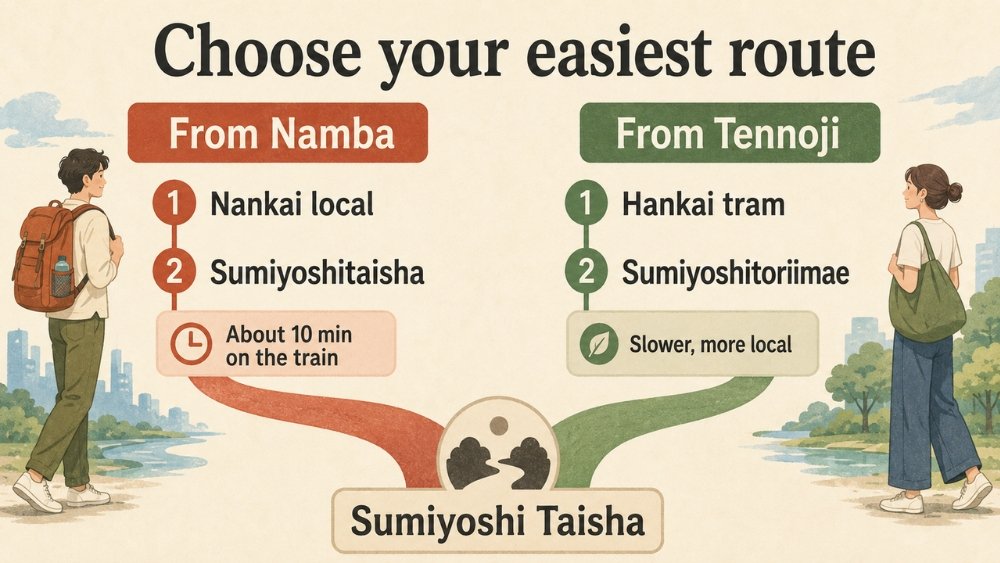
Sumiyoshi Taisha is in southern Osaka, away from the busiest sightseeing core but easy to reach. The best route is usually the one with the fewest decisions from where you already are.
| Starting area | Easiest route | What changes the choice |
|---|---|---|
| Namba | Nankai local to Sumiyoshitaisha Station | The most direct option; check that the train is a local |
| Tennoji or Abeno | Hankai tram to Sumiyoshitoriimae | A slower neighborhood ride that arrives beside the shrine |
| Umeda or Osaka Station | Reach Nankai Namba, then take a local train | Expect at least one transfer and allow time to find the correct Namba station |
From Namba: use the Nankai local
Nankai’s current network information shows Sumiyoshitaisha as station NK08 on the Nankai Line, served by local trains. Nankai also gives the Namba–Sumiyoshitaisha ride as about 10 minutes. Check the departure board rather than assuming every southbound train stops there; airport and limited-express services are not the right choice for this short trip.
Namba contains several stations run by different operators. For this route, you need Nankai Namba Station, not JR Namba and not simply the nearest Osaka Metro entrance. Save both ends before leaving:
- Nankai Namba Station on Google Maps
- Sumiyoshitaisha Station on Google Maps
- Nankai’s Sumiyoshitaisha Station page
An IC card is a rechargeable transit card used by tapping at compatible gates or readers. ICOCA is the local JR West-branded card, while other major compatible cards also work across much of Osaka. Check current operator guidance if you are unsure about your card, and keep enough stored value for the return.
From Tennoji: make the Hankai tram part of the visit
The Hankai Uemachi Line links Tennoji-ekimae with the Sumiyoshi area, and Sumiyoshitoriimae is the stop beside Sumiyoshi Taisha. This route is useful when you are already around Tennoji or Abeno and prefer a street-level journey through residential neighborhoods.
Hankai’s official route map distinguishes Sumiyoshi and Sumiyoshitoriimae. For the shrine entrance, Sumiyoshitoriimae is the clearer arrival point. Check the current Hankai route map and timetable before departure because service patterns can change, and save Sumiyoshitoriimae on Google Maps.
If you are still learning Osaka’s transport system, the Nankai route from Namba is easier to explain and repeat. Choose the tram because it suits your starting point or because you want the ride—not because it is universally simpler.
Check the hours before you build the day around the shrine
The shrine’s current FAQ lists visiting hours as 6:00 a.m.–5:00 p.m. from April through September and 6:30 a.m.–5:00 p.m. from October through March. Entrance is free. The souvenir shop is listed as open from 9:00 a.m.–5:00 p.m., with no fixed holidays.
Those hours do not mean every counter, ritual, or special area operates for the entire window. If you want a goshuin—a shrine seal written or stamped into a dedicated book—or a particular charm, do not arrive just before closing. Bring Japanese yen: the shrine’s FAQ says credit cards are not accepted for purchases at the souvenir shop and Nankun-sha.
For an ordinary calm visit, morning gives you the most breathing room. Late morning is still practical if you are combining the shrine with lunch or another south-Osaka stop. Summer heat and exposed walking can make the same route more tiring, so carry water for before and after the grounds; the shrine asks visitors not to eat or drink inside the precinct.
New Year is a different kind of visit. Sumiyoshi Taisha says more than two million people visit at the beginning of the year. Treat the first days of January as a major event, not as the quiet one-hour visit described here. The annual Sumiyoshi Matsuri, normally held from July 30 to August 1, also changes crowding and movement. Recheck the official rituals and ceremonies page when your dates overlap a major observance.
Notice three things instead of trying to see everything
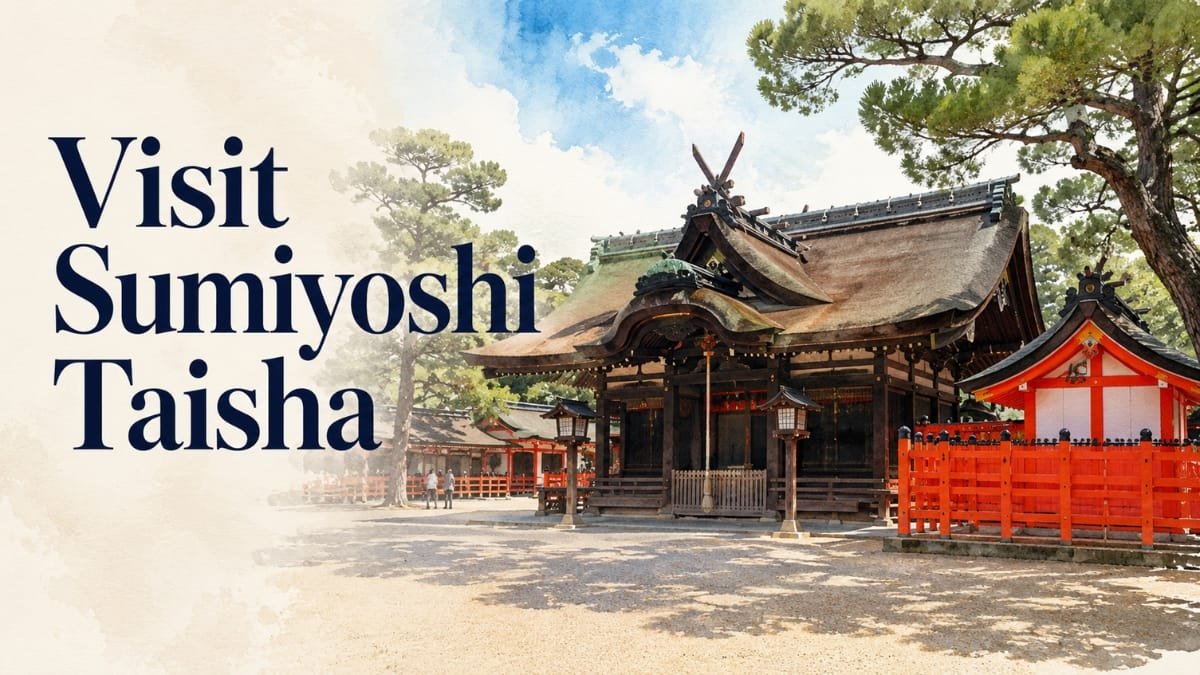
Sumiyoshi Taisha is the head shrine of approximately 2,300 Sumiyoshi shrines across Japan. Its present four main sanctuaries date from 1810 and are designated National Treasures. Their straight-lined form is known as sumiyoshi-zukuri, an early shrine architectural style with a simpler profile than the curved, highly ornamented buildings some visitors expect.
You do not need to turn the visit into an architecture lesson. A first visit works well when you give three elements proper time:
- Sorihashi Bridge. The steep arched bridge is also called Taikobashi, or “drum bridge,” for the circular shape formed with its reflection. The shrine connects crossing it with purification. The slope exceeds 40 degrees at its steepest point, so use the steps and handrails carefully.
- The four main shrines. The three shrines for the Sumiyoshi deities stand on an east–west line, while the fourth sits beside the westernmost one. Pause far enough back to understand the arrangement rather than moving only from offering box to offering box.
- One optional detail. Choose a goshuin, one smaller shrine, the stone stage, or a quiet loop through the grounds. Trying to complete every minor stop makes a short visit feel mechanical.
The shrine’s official precinct map and background is the best current reference for deciding whether a smaller site matters to you. Open it before arrival rather than trying to decode every label while standing in the path.
The steep bridge is optional
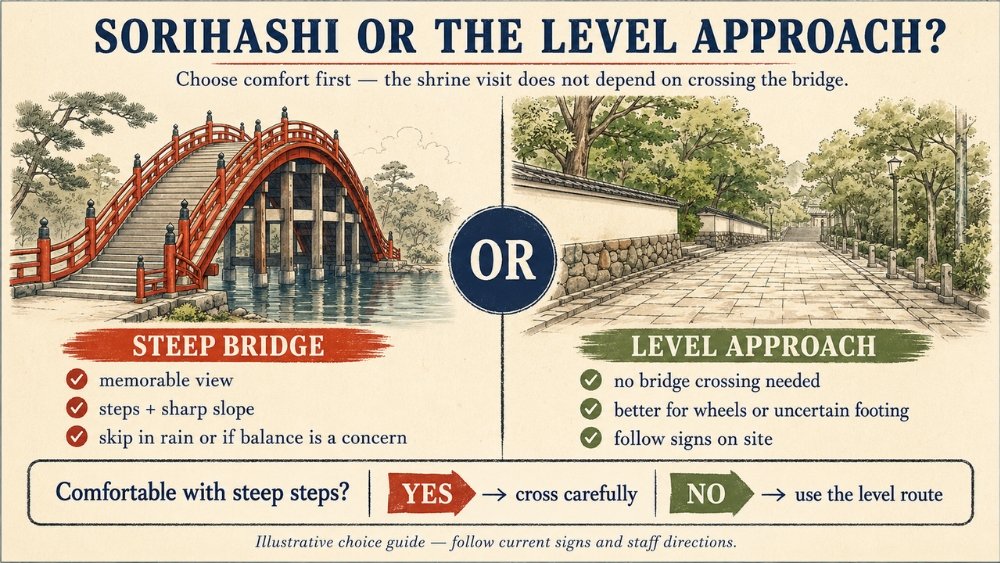
Sorihashi is the shrine’s visual signature, but crossing it is not a test. Its steep steps can be difficult when the surface is wet or when balance, mobility, footwear, a stroller, or fatigue makes a sharp climb uncomfortable. Use the handrails and take your time if you cross.
If the bridge is not right for you, use a level approach instead and follow current signs or staff directions. The shrine FAQ directs visitors to the information desk for wheelchair-accessible restroom and diaper-changing information. It is sensible to ask there about the best current route for your needs rather than relying on an illustration or an old map.
A simple sequence keeps the visit calm
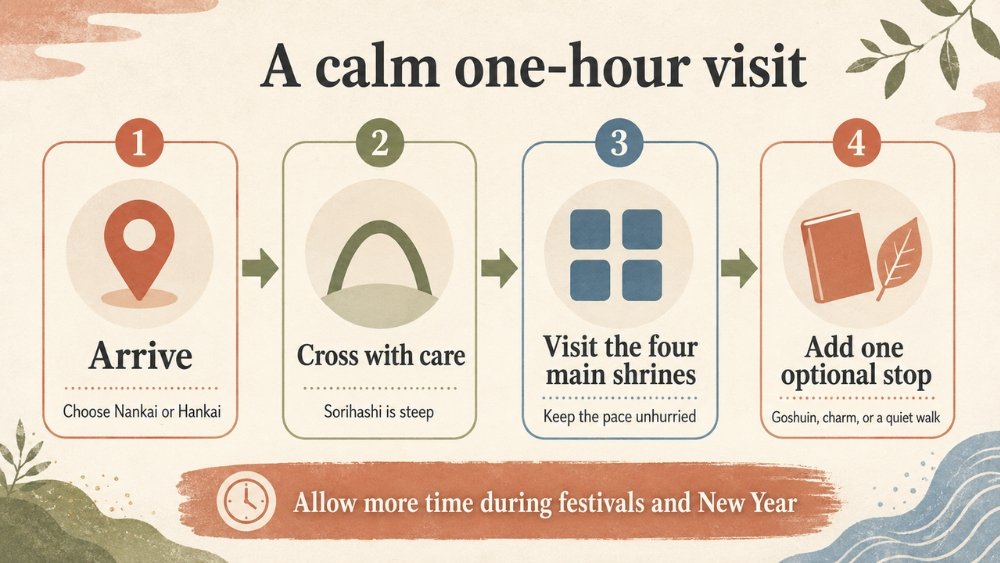
Start by orienting yourself at the western approach. Cross Sorihashi only if its steep steps feel comfortable, then continue toward the four main shrines. Give the main sanctuary area your attention before deciding whether you have time and energy for one optional stop.
At a Shinto shrine, a torii marks the transition into sacred space. It is customary to keep to one side rather than walking through the exact center, which is symbolically reserved for the deities. At a purification basin, called a temizuya or chozuya, visitors may rinse their hands before prayer. Participation is optional. If the basin is closed or you are unsure of the current practice, continue respectfully without improvising.
At many shrines, the common prayer pattern is two bows, two claps, then one bow. Follow posted instructions because local practice can differ. A small offering is optional, not an admission charge. Keep your voice low near worship spaces, avoid blocking the approach for photos, and follow any photography signs.
The shrine’s FAQ asks visitors not to eat, drink, smoke, or fly drones within the grounds. These rules are more useful than a long etiquette checklist: move calmly, observe the signs, and leave space for worshippers.
How long to allow
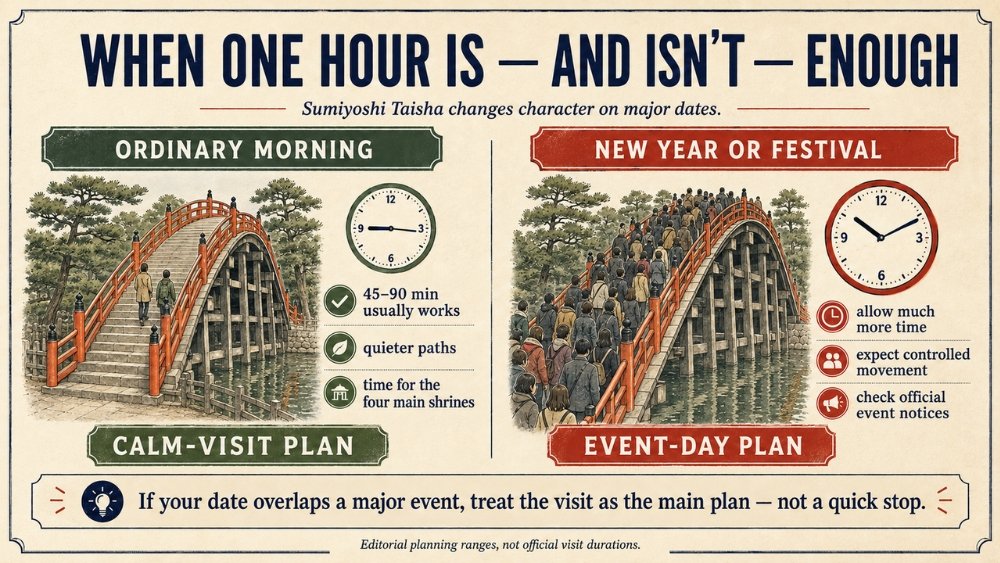
For most first-time visitors, 45–90 minutes is a useful Osaka Map planning range, not an official required duration. Around 45 minutes can cover the bridge area, the four main shrines, and a short walk when the grounds are quiet. Around 90 minutes suits travelers who want to read the precinct information, receive a goshuin, or explore a smaller shrine without rushing.
Add buffer time when any of these apply:
- you are visiting during New Year, a festival, or a ceremony;
- you are traveling with a stroller, wheelchair, or someone who needs frequent rests;
- rain makes Sorihashi or stone surfaces slower;
- you want a goshuin or charm near the end of counter hours;
- this is your first trip through the Namba station complex.
On a major event date, treat Sumiyoshi Taisha as the main plan for that part of the day rather than a quick stop between reservations. Crowd controls, queues, and changed access can make an ordinary one-hour estimate meaningless.
Pair it with the right kind of half day
Sumiyoshi Taisha works best as the anchor of a calm south-Osaka morning or half day. From Namba, the direct local train makes it easy to return for lunch and a busier afternoon. From Tennoji, the tram ride can become part of a slower neighborhood itinerary.
The shrine stands next to Sumiyoshi Park, but a nearby location does not automatically require another full attraction. Add the park when the weather is pleasant and you want a longer walk. If energy is limited, return after the shrine rather than filling the schedule simply because something else is close.
If you continue toward Sakai, check the current rail route and the opening hours of your next stop before leaving the shrine. Do not assume a map’s geographic direction equals the simplest service pattern.
For destination orientation, use the official Sumiyoshi Taisha site together with Sumiyoshi Taisha on Google Maps. The official page is the source for hours, rules, events, and precinct information; the map is the practical tool for reaching the entrance.
Leave room for the quiet part
The easiest Sumiyoshi Taisha visit is not the one with the most stops. From Namba, take the Nankai local and check that it stops at Sumiyoshitaisha. From Tennoji, use the Hankai tram when a slower street-level ride suits the day. Arrive with enough time before 5:00 p.m., treat Sorihashi according to your comfort and the weather, and give the four main shrines your attention before adding anything optional.
That modest plan is what lets Sumiyoshi Taisha do its real work in an Osaka itinerary: slow the city down for an hour without turning the visit into a transport project.